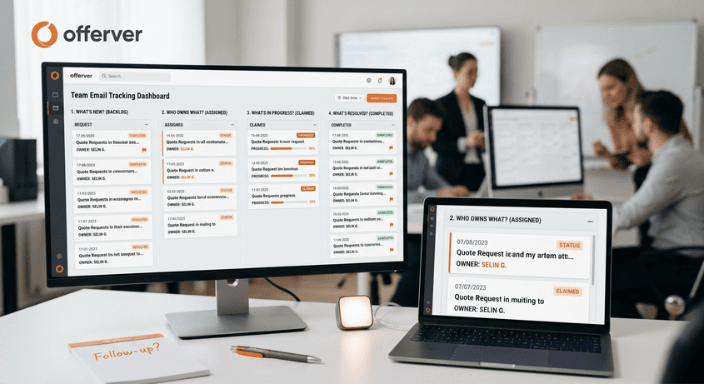
When B2B sales teams grow past two or three people, the shared inbox starts breaking down. It was never meant to be a coordination tool. It's just an email folder that multiple people can open. What happens inside that folder—who read what, who responded to whom, who is working on which quote—remains completely opaque.
Team email tracking is the practice of making that coordination visible. It's not about surveillance. It's about making sure nothing falls through the cracks when you have more work than one person can handle.
What "Tracking" Actually Means
There's a distinction worth drawing here between individual email tracking (did the customer open my email?) and team-level email tracking (which requests is our team currently handling, and who owns each one?).
Both are useful, but they solve different problems. Individual tracking helps salespeople follow up at the right moment. Team tracking prevents duplication, confusion, and dropped requests. Most sales tools do the first well. The second is often an afterthought.
For teams handling a high volume of inbound quote requests, team-level tracking is the more critical of the two. A request you don't follow up on is a problem—but a request no one even knows about is worse.
The Four Things You Need to See
Effective team email tracking for quote requests means having a clear answer to four questions at any moment:
1. What's new? Every request that arrived since the last check-in, not yet assigned to anyone. This is the inbox equivalent of a task backlog.
2. Who owns what? Once someone takes a request, it should be clearly attributed to them. Not implicitly—the way an email looks "read" in a shared inbox—but explicitly, with a name attached.
3. What's in progress? Requests that have been claimed but not yet resolved. These need monitoring. How long has it been? Is it close to a response deadline?
4. What's been resolved? Completed requests, with their outcome. Quoted, declined, cancelled. This is the record that makes future analysis possible.
If your current setup can answer all four of those questions without anyone having to ask around, you're in good shape. Most teams can't.
How Miscommunication Happens
The most common failure mode in shared inbox environments isn't neglect—it's invisible overlap. Two people each see an unread request. Both start working on it. One sends a quote. The other, unaware, calls the customer to ask clarifying questions. The customer is confused about who they're dealing with.
This is embarrassing at best and deal-killing at worst. It's also entirely preventable once requests have explicit owners.
Another failure mode is the handoff that doesn't happen. Someone starts working on a request, goes on vacation, and the partially-complete draft sits in their local email client. Their colleagues don't know it was in progress. The customer hears nothing.
Both of these failures are visibility failures. The solution is the same: make the state of every request visible to everyone on the team.
Making Tracking Feel Natural
The reason most teams end up with ad-hoc tracking (a spreadsheet, a Slack message, a sticky note) is that proper tracking tools have historically been either too heavy (full CRM) or too generic (project management tools that weren't designed for email workflows).
The right tool for inbound quote requests should feel like a natural extension of how your team already works. Emails arrive. Someone picks one up. They work on it, send a response, and mark it done. The tool's job is to make each step visible to the rest of the team without adding paperwork.
When tracking is that frictionless, people actually use it. When it requires discipline and extra steps, people revert to the shared inbox and hope for the best.
For B2B teams that live in their inboxes, visibility is the difference between a team that scales gracefully and one that grows more chaotic the busier it gets. Team email tracking isn't a nice-to-have—it's the scaffolding that makes coordinated sales work possible.